Love Your Archives
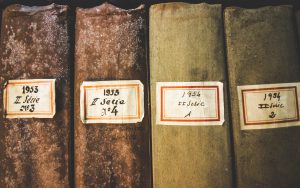
It was sad to read in ‘Who Do You Think You Are?’ that Archives wouldn’t reopen until ‘September at the earliest’ – I miss my trips to the archives and the people I meet, and cannot wait for them to open again – safely of course.
I have loved libraries, bookshops, and museums for more years than I care to admit, but I am a relative newcomer to the archives. Until my passion for family history really took hold, I imagined archives to be dark, gloomy places where you are told to ‘Shhhhh’ if you raise your voice. That is not my experience.
Readers of my last blog may remember me celebrating the completion of three years of study for the IHGS certificate. You may also recall I said it was not a ‘sitting behind a computer’ qualification but an ‘in the field, hands-on, eyes down kind of qualification’. The extensive lectures were not based on theory but on practice – this meant visiting many different archives to research documents to complete the assignments. Since my first archive visit to the Wiltshire and Swindon History Centre, I have explored documents in archives in Hampshire, Surrey and London. I have read ancient records in two castles and have even found my own shoemaker ancestors recorded in 300-year-old chancery records.

Not as scary as I thought
I’m a bit of an old hand now, but I remember my first visit to an archive was quite daunting. Before I headed for the Wiltshire and Swindon History Centre I prepared for my visit. Although most archives have shelves filled with books and indexes, most of their documents are stored in locked, temperature-controlled rooms, so you have to use a catalogue to find out what is available. Luckily catalogues are available online so you can figure out what to order before you get there. At some archives you can also book documents in advance, so they are ready for you when you arrive. You may need a reader’s ticket to use the archives. This is likely to require registration and some form of identification. Each archive has a different way of doing things, so it’s best to check their website first.
The National Archives website has a really useful guide for ‘newbies’ – not just to the TNA but for visiting archives in general.
What did I find?
My ancestors came from the small villages of Shalbourne and Ham, on the Berkshire and Wiltshire border. I wanted to see what one of my ancestors was doing in the 18th Century between his baptism and burial. I wanted to find out where he came from because he wasn’t born in either village; and I wanted to understand more about the community in which they lived and worked.
The staff at WSHC were very helpful – even more so when I explained it was my first visit. I ordered the documents I needed and while I waited for them to arrive at my allocated table, I explored the library (of course).

In the period after his marriage in 1764, my 6th great-grandfather George Whale got paid to make shoes (lots of shoes) for the poor of the village of Ham.
I found this in the Overseers’ Account Books for the parish. Overseers’ Account Books are a fabulous read. They were kept because under the Old Poor Law (1601-1834) each parish was responsible for its poor. Money was raised from parishioners through the ‘poor rate’. From these funds, the church provided a miniature ‘welfare state’ for the parishioners who were unable to support themselves; usually the elderly, widows, children, and the sick. Expenses could include paying the parishioners rent, providing clothing (and shoes), and paying for a burial.
Account Books often name recipients and can also signpost events. An entry from Shalbourne in 1770 noted . . . ‘Paid Dame Whale for laying out of Robert White’. This indicated the death of poor Robert, and give a damn fine clue of the date of his death – which would be particularly useful if the burial register didn’t exist.
I didn’t, however, find out where he was born. . . this is still a rather frustrating brick wall.

Next, I went large
I am lucky to have The National Archives (TNA) close to where I live. Their tagline “Explore 1,000 years of history” indicates the extent of their holdings. So, it’s a good idea to prepare before you head out the door.
TNA provides a guide to their catalogue ‘Discovery’ which will tell you about their holdings and the holdings of other archives and institutions.
I also did a ‘Behind the Scenes Tour.’ Being shown around the building by someone in the know was so helpful. The tour introduced me to the security procedures and showed me the various reading rooms. I saw how vast the premises are and I got to see some examples of some of the many of the historical documents they keep safe. It was a great experience and meant, at my next visit, I knew what to do.
Some best finds
What is available on the internet is just the tip of the iceberg. By researching at the archives you may find some nuggets of information about your family that you would never find. Here are just a few of my favourites.
Property Deeds – these are essential for tracing the history of a property and they are also useful to confirm relationships where a property was subject to inheritance. Whilst plentiful, deeds are not always easy to find; often they are not indexed. But they are worth persevering with. I asked one Archivist if there was an index for their collection of Deeds. The response was: ‘no-one had committed a sufficiently heinous crime to have to index all our deeds’. That’s a ‘no’ then.
Sometimes the smallest of documents give the greatest result. In search of family connections, as a last resort, I ordered an Abstract of Title to a property in Lympsfield, Surrey. An abstract is a summary of all the title deeds relating to a particular property. A very small, delicate, handwritten two-page document arrived at my table. I was not expecting much. How wrong I was. Much to my surprise, the abstract included the names and relationships of 12 people of the family I was researching going back to the 17th century. A great find indeed!
The Italian Job – Pre-Brexit, and with a view to obtaining an Italian passport, I was asked to see if I could find any papers relating to an Italian grandfather. Naturalisation records are held at The National Archives. From these records, I learned ‘grandad’ had come to England in 1911 from Pisa. The documentation included the names of his parents and their places of birth and a list of all the addresses at which he had worked and lived up to 1929. And now the icing on the cake! In addition to his family information, the file included documents in respect of libel action he took against the press. He had been accused by the ‘Daily Sketch’ of being ‘an anarchist and an associate of criminals’. Further research revealed he had won his case and had been awarded a substantial sum of money.
X-marks the spot – I was searching for the earliest mention of a residential property in Chertsey in Surrey that used to be an Inn. The census and land tax records had been exhausted and the Deeds were being elusive. So I turned to maps. The land on which the property sat was part of the Manor of Chertsey Beomond. Surrey History Centre held a plan of the land. Described as a ‘Plan of His Majesty’s Manors of Chertsey, alias Chertsey Beamond and Harwick in the County of Surry. . . . ‘ By Thomas Richardson, Surveyor in 1772. The Anchor Alehouse was clearly marked. Another piece of the jigsaw found; onto the next piece.
Researching an ancestor is like detective work; evidence can be found in lots of different places. Our ancestors lived full lives in between their birth and death. Even lowly agricultural labourers can be mentioned in parish records. And if they were a wee bit naughty they may be mentioned in the records of the Quarter Sessions.
There really is nothing like handing records ‘in the flesh’ and realising that your hand is touching the same document your ancestor touched 300 years ago.
 Whatever you call them – archives, family history centres, county records offices – they are all veritable Aladdin’s Caves of information for researchers of family, social and local history and are much missed.
During lockdown, I have discovered a lot of new internet sources and many archives have made some of their records available online for free. But it’s just not quite the same and I am so looking forward to putting out the bunting when I hear the news that our archives, history centres, libraries and museums are to open again. And I look forward to seeing you there too!