Who was W.P. Watkins?

Whose trunk is this?
Nextdoor.com is an app where people go for local news, trade recommendations, etc. I joined the one for Emsworth in Hampshire when I moved here just over 18 months ago. It’s been a great way to find out what’s going on nearby, but one particularly unusual post caught my eye, it read “This is a really long shot. But does this Trunk mean anything to anyone locally?”
The trunk was found by Alex who was clearing an overgrown area of her allotment. The trunk was old and rusty but most of the wording was legible and it started up a really interesting conversation.
The box, according to Jan of Southbourne, was “an Officer’s chest for personal belongings, military equipment, and uniform.” She said the six-digit number was the person’s Service Number (a unique number allocated to everybody who serves in the military). The letters WG/CDR is the rank and stands for Wing Commander . . . . usually the highest rank on an RAF Station (which Thorney Island once was) so she said this was potentially the Station Commander’s personal trunk” Jan also noticed that the letters REV were before WG/CDR suggesting the box may have belonged to a former Padre.
Rosemary of Rowlands Castle suggested that the box was called a “foot locker” and agreed with Jan that the Rev title would indicate the owner was a service Padre. She suggested he would not have been the Station Commander, as this role would have probably been a Group Captain (the rank above Wing Commander).
Jan did a bit of digging and on the website of St Nicholas’s church, West Thorney, she found a reference to a Paul Watkins who had been an RAF Padre there. The written memory, which wasn’t dated, said:

Les Marshall of Dripping Springs, Texas
First Steps
Wondering if Mr Watkins would be recorded on the Army Lists, I did a little digging myself. Army lists recording details of officers who served Britain’s armed services have been published since the 18th century. I found that Chaplains, were also included in these lists as they fall within the Officer category. And there among the lists for the 1940s was Captain W.P. Watkins of the Royal Army Chaplains Department. The website https://www.forces-war-records.co.uk/ also included references to him from 1941.
I mentioned this in the Nextdoor chat and Lesley in West Wittering wrote “Oh how wonderful you are all starting to trace its history and hopefully owner.”
Never one to pass up a challenge, I thought why not?!
—————————————————
First Steps in the search for W.P. Watkins
The main guide to Anglican clergy in Great Britain is Crockford’s Clerical Directory. The Directory for 1947, contained an entry for William Paul Watkins who graduated from Lincoln College, Oxford in 1937 and was ordained in 1938, and who was at Thorney Island between 1964-1968. We had our man!

Crockford’s Directory
From the information in this small biography, it was clear he was a Chaplain. From the locations, it appeared he had been a Chaplain for the RAF from 1955. I next contacted the Royal Army Chaplains’ Museum. The Museum Curator, David Blake kindly sent me information relating to William’s service.
So with the information from the Biography, the Museum, and with a little help from the newspapers, I was able to piece together the life and career of William Paul Watkins.
The Career of W.P. Watkins
William Paul Watkins was born on the 25th March 1913 in Richmond, Surrey; his parents were Thomas William Watkins and Lilian Stutchbury.
Knowing he was based in Norbury between 1938 and 1940 I searched for him on the 1939 Register. The 1939 Register is one of the most important 20th-century resources for tracing family history in England and Wales. Personal data was collected from everyone living in England and Wales in order for National Identity cards to be issued. Data collected also formed the basis of the subsequent NHS registration system; this accounts for many changes on the Register, such as the crossing out of a maiden name and the writing in of a married name, as we will see below. The 1939 Register is also important as it fills a gap in the census records. The 1931 census was destroyed by fire during WW2 and no census was taken in 1941 because of the war. So, the 1939 register is the only national census-like resource available for this period.
At the time the Register was taken, William Paul Watkins lived at 13 Pollards Wood Road, Croydon, Surrey, which is fairly near Norbury. (Ref RG101/1282E/016/13). His date of birth was a match, the 25th March 1913 and he was a Clerk in Holy Orders (the legal title for a member of the clergy).
In 1940 he was the Acting Chaplain of St. Peter’s in Maidstone. By late 1941 he had returned to Croydon where he married Margaret Ann Gould. Margaret worked for the Railways as a Tracer for the London Passenger Transport Board. The 1939 Register shows both her maiden name and her married name.
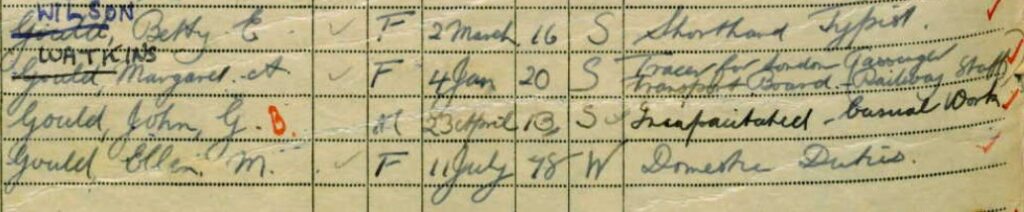
Margaret Gould – 1939 Register
William Paul Watkins joined the Royal Army Chaplains Department on the 17th September 1941 for the duration of WW2. He served in several places in the UK before being sent to North Africa. He remained with the Royal Army Chaplains Department until the 25th September 1946.
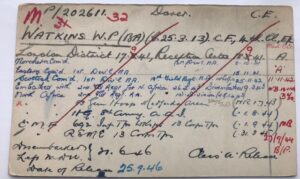
A year after the end of the Second World War, William and Margaret moved to Harby, Leicestershire with their new daughter Anne. William’s appointment to the post of Rector was reported in the Leicester Evening Mail of the 1st March 1949.
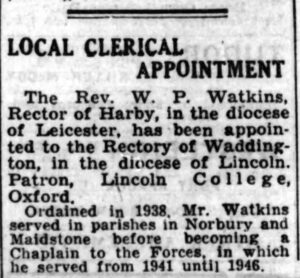
Leicester Evening Mail
In 1949 he became the Rector of Waddington, Lincolnshire where in 1950 William and Margaret had a son, Roger. The family remained in Lincolnshire until 1953.
William’s career took him to RAF Marham in 1953 where he spent two years as Chaplain. That year, the Battle of Britain was commemorated with a service at St. Margaret’s church, King’s Lynn, Norfolk. The Lynn News and Advertiser of the 22nd September 1953 reported that Squadron Leader, the Rev. W.P. Watkins, Marham RAF Chaplain recalled the battle. He was reported to have said, “We should recall with utter thankfulness the men living or dead who by their courage, spirit and devotion won for this country and for the whole world our salvationary victory.”
Between 1955 and 1958 Paul was based at RAF Seletar in Singapore. He was joined in Singapore by his wife and children whose outward journey was recorded on the passenger list of the ship “Dilwara” in June 1955. The family remained in Singapore until 1958 when they returned to live at “The Anchorage” Holt Road, Sheringham, Norfolk.
William was next posted to RAF Boscombe Down, Wiltshire in 1959. He remained there for a year before transferring to RAF South Cerney near Cirencester, Gloucestershire.
After RAF South Cerney, he was then posted to RAF Geilenkirchen in the North Rhine-Westphalia region of Germany where he stayed from 1962 to 1964. It was on his return from Germany that, on the 19th August 1964, he was posted to Thorney Island, Hampshire. His appointment was announced in The Times on Tuesday 8th September 1964.

The Times
William stayed at Thorney Island until the end of 1967. After this he remained in the area, being appointed to the role of Rector of the West Sussex villages, Stopham and Hardham at the beginning of 1968. He moved away from West Sussex in 1972 and returned to Norfolk where he spent the remainder of his life.
William Paul Watkins died on the 2nd October 1975 at Matlaske Rectory, Matlaske, Norfolk. In his will, he left his entire estate to his wife, Margaret. No other bequests were made and no other names were mentioned.
 What next?
I have searched newspaper archives, RAF archives, and many other places for a photograph of Reverend William Paul Watkins. . . all with no success. Do you remember William Paul Watkins? Did he baptise your child? Did he conduct your wedding? If you can help with a photo, please get in touch.
I know that the trunk will not be returned to its owner, but it would have been nice to have been able to give it to one of his descendants. However, the search has reached a sticking point – the genealogical brick wall – however, there is reason to believe that William’s wife left England to live with her sister in Canada, so the search continues.
If you have enjoyed reading this blog and would like to make a small donation to the Chaplains Museum, the Curator would be delighted. The Royal Army Chaplains’ museum at Shrivenham, Oxfordshire – https://www.facebook.com/Royal-Army-Chaplains-Museum-100481625164908/