Remembering them
Victory in Europe Day — Hythefield Avenue

My parents were both born during the Second World War. In fact, my Dad is just a toddler in this photo, taken on 8th May 1945 in Hythefield Avenue, Egham, Surrey. My mother was only 3 months old. Their memories stretch back as far as rationing, and the stories they heard about family and friends.
Just one generation back reveals so many people who played their part in WW2. Through the course of my research, I have written about a number of them. Extracted from wider research are the stories of three brave men who served in each of the main Forces. Let’s remember them.
Arthur Whale – Royal Army Pay Corp
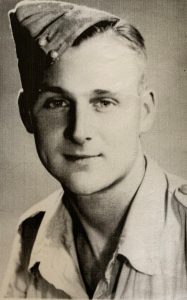 My Great Uncle Arthur William Whale “Bill” served with the R.A.P.C. in WW2. The Royal Army Pay Corps (R.A.P.C.) were the paymasters for the officers and soldiers serving in the army; dealing with military expenditure at home and in the field.
In WW2 Bill served with the R.A.P.C. in North Africa. His ‘Passed by Censor’ letter was written to my grandfather, his oldest brother. He refers to his other brother Bob and also to his small nephew Billy. The letter says
“Dear Walt, received your air letter, complete with Billy’s effort. We will soon be knowing too much. Very pleased to hear news of Staines Vale Football Club. I have an invitation to play for Hounslow Town when I get back but if there is a decent game nearer still it will suit me better. Have not heard from Bob yet but apparently he has sent some razor blades off. They will be more than welcome. At the moment I am using old ones which were well used before I left England. If they don’t arrive soon my beautiful profile will be ruined (?) Am trying to get some photographs taken, but it’s hell’s own job. I think Alf Harper has some films on the way though so we may be lucky. Remember me to the Comp. I suppose they are still crazy over solo. I’ve learned Bridge since arriving and solo is rather out of the picture for a while.
Well it’s grub time, so much say cheerio now or I’ll miss my dinner. Love to Glad and the nippers.
Yours Bill Whale
P.S. I’ve been pickled once only – the last time.”
Bill was one of the lucky ones. He came home, married and had a family. He never did play football for Hounslow Town but he did play for Staines Town FC. He was mentioned a couple of times in the local Staines & Ashford News. One report in January 1950 saying that despite having a terrible game ‘Bill Whale at left-back saved on the goal-line many times throughout the game and deserves special credit for some good anticipation’.
Ernest James Moorsom Blandford – Royal Navy
England has Henry VIII and his love of ships to thank for the Royal Navy. Being an island, the Royal Navy has been essential in defending the country since then. By the beginning of the 19th century, it employed over 100,000 people. Its officers were a professional force and often very young. The captain of a warship could still be in his early twenties.
Its part in the Second World War was of paramount importance to Britain. As well as defending the country, it kept our trade routes open. The safe passage of food and fuel into the country was essential.
As well as operations on the sea, the Royal Navy had crews in its many submarines under the sea. One submariner was Ernest James Moorsom Blandford. Ernest was born in Portsmouth in September 1914. His father James Moorsom Ernest Blandford was also a seaman.

Ernest attended the Greenwich Hospital School, signposting a family connection with the Royal Navy that went back to the 1700s. He joined the Royal Navy in 1932 and served onboard HMS Suffolk. In the summer of 1939, he married Nesta Barnes and their son James was born in Copnor the following year. The photograph is of Ernest with baby James — one of the few of them together.
In the Spring of 1941 Ernest was among the crew of the submarine HMS Undaunted. At the beginning of May, the submarine sailed from Malta to patrol off Tripoli. It failed to return on her due date of 11th May and no contact could be made with the submarine. It was believed the submarine was torpedoed by the Italian torpedo boat Pegaso.
Ernest and the crew of Undaunted are remembered on the Portsmouth Naval Memorial.
Ronald O’Donnell – Royal Air Force
I grew up watching The Dambusters movie with my Dad. I am still happy to sit and watch Richard Todd as Wing  Commander Guy Gibson.
The film tells the story of the audacious bombing raid by RAF 617 Squadron on three dams in the Ruhr valley. Whilst there is a degree of romanticism in the movie, it also reminds us that pilots and crew were often very young. The average age of an RAF fighter pilot in 1940 was just 20 years old.
I was recently asked to settle a small disagreement over a date. Memories had faded and agreement could not be reached on whether their relative, Ronald O’Donnell, died during the Second World War or after the war.
What I discovered was heartbreaking. On 17th May 1945, the crew of 630 Squadron was killed when their plane crashed. They had been carrying out a routine cross country training flight. The Lancaster Bomber had taken off from the RAF base at East Kirkby in Lincolnshire. As they approached the Wolverhampton area the plane was in trouble. It was an overcast day. Witnesses said they heard the plane before they saw it. As it came out of low cloud it was clear one of the engines was on fire. The plane plummeted to the ground and crashed into a road near Moat House Farm at Short Heath, Wednesfield. The Lancaster was completely destroyed and the crew of seven killed on impact; all were under the age of 24.
Among the crew was Flying Officer Ronald James O’Donnell of the Royal Air Force Volunteer Reserve. Ronnie was the 21 year old son of James and Kathleen O’Donnell of Pennycomequick, Plymouth, Devon.
So, Ronnie had died after VE Day. The fact he died so soon after was sobering. He never would go home to Plymouth and James and Kathleen would never see their son again. His life is remembered in Ford Park Cemetery, Plymouth.
Doing your own research
Bill, Ernest and Ronnie were among the hundreds of thousands of men and women who risked and lost their lives to ensure freedom and peace for generations to come. It was a pleasure to learn about them and their lives.
If you want to find out about your own WW2 Ancestors many resources are available in archives and museums across the country.
One of the best places to start your research is at The National Archives
If you are interested in learning more about your ancestor’s military service, you can get copies of World War Two military records from the Government website
The Imperial War Museum has an amazing collection of documents and photographs from the twentieth-century conflicts.
Lockdown learning
This year although most of us will be confined to barracks due to coronavirus, VE Day will still be celebrated. Our street is holding a social-distanced street party (a picnic in the front gardens). Many planned events have moved online, including this one: The National Museum of the Royal Navy, the National Army Museum and the Royal Air Force Museum are joining forces to host a free three-day online festival. Click here to bring to life more stories of those who helped deliver Victory in Europe. http://www.nam.ac.uk/whats-on/virtual-ve-day-75-festival